
Welcome page
SHOULD in an app that opens files or projects: the page shown when there is no
session to restore, and the answer to “what do I do now?”. An app whose window is its content shows its own empty
state instead, with the same ingredients (Torrenta’s drop zone, below). Reference: Editora’s ui/WelcomePane.java,
with the text rules in ui/WelcomeText.java and the strings under welcome.*.
Anatomy
Section titled “Anatomy”
- 1Identity. The app icon at 64 px beside the name (2.4 em, bold) and the README's one-line tagline, muted. One centered column, at most 640 px wide and never narrower than 340; a longer window scrolls.
- 2Start actions, each an existing command: New File, Open File, Open Folder as a Project (only with Projects on), Clone Git Repository (only with Git on), and the Command Palette always last, the gateway to everything else. Accent links with no box; the icon sits in a 26 px column so every label starts at the same x, and the whole row answers a click.
- 3Chord, right-aligned past a 32 px gap, in the keyboard color, from the active keymap. Unbound: no chord. Open File shows find-file's chord in the Emacs keymap, where that is the key to learn. The hovered row tints and the chord becomes a chip.
- 4Entry number. The first nine recent entries, projects first, are numbered in the keyboard color; typing that digit opens the entry. Projects come in the order of their most recent file.
- 5Recent file row. The name keeps its width; a chip names the project (or the host of a remote file); the folder is muted, relative to the project root, with
~for home, and elides from its start so the part that differs stays visible. The full path is the row's tooltip; right-click offers Copy Path and Remove from recent files. - 6Disclosure. Five rows per list; the rest wait behind "Show N more", which becomes "Show fewer".
- 7Customize. The active keymap and app theme by name; each link runs the picker command. Under an Emacs-style keymap a caption explains the notation. On a first run, with nothing recent, this block moves up under Start.
- 8Help and footer. Documentation, What's New (the release notes) and the Doctor. Then the version, the home page and the license; a dev build adds its commit on its own line once the lookup, which runs
gitoff the FX thread, has answered.
| Property | Value | Reference |
|---|---|---|
| Kind | A real tab content in its own closeable “Welcome” tab, so the tab strip handles switching and closing; not an overlay | WelcomePane implements TabContent, MainController.addWelcomeTab |
| Column | 640 px max, 340 px min, 48 px margin, centered in a scroll pane; below the minimum the page scrolls sideways | COLUMN_WIDTH, MIN_COLUMN_WIDTH, MARGIN |
| Zoom | Every px size is multiplied by the text zoom and the fonts are em, so zoom scales the layout, not only the words | setFontScale, .welcome-* |
| Surface | -color-bg-default, the UI surface, not the editor’s; its tab takes the same fill | .welcome-pane, .ui-surface-tab |
| Header | Icon 64 px; title 2.4 em bold; tagline -color-fg-muted | .welcome-title, .welcome-caption |
| Section heading | 1.15 em bold, padding 28 0 8 0 | .welcome-section |
| Links | Hyperlink in -color-accent-fg, no border, underlined only on hover or keyboard focus; visited stays the accent | .welcome-action, .welcome-link |
| Action row | Icon column 26 px, gap 12 to the label, at least 32 px to the chord; hover fills -color-bg-subtle with 6 px radius, insets 8 px past the row | WelcomePane.action, .welcome-action-row |
| Chord | -state-key, 0.9 em; on hover a -state-key-bg chip, radius 4 | .welcome-key |
| Recent row | Number -state-key 0.8 em; folder -color-fg-muted 0.9 em with a leading ellipsis; project chip muted on -color-bg-subtle, radius 3 | .welcome-entry-number, .welcome-recent-dir, .recent-project-name |
| Lists | 5 rows, then a flat disclosure button | COLLAPSED_RECENT_LIMIT, addCollapsed |
| Focus | The first recent entry, or New File when there is none, with no focus ring; Enter and Space open it | requestFocus, focusPage |
Behavior
Section titled “Behavior”- Shown at startup when there is no session to restore (so always with
--no-session), by theview.welcomecommand (Help → Welcome Page), and when the tab strip is empty after a project swap (showWelcomeIfNoTabs). Standalone diff startup suppresses it while its worker reads the files. - Closing the last file tab does not bring it back. The editor area shows its own quiet hint instead: Open File,
Open Folder, Command Palette and Welcome Page, each with its chord (
EditorEmptyState), and takes focus so chords still reach the window. - Rebuilt on every show (
refresh), so the recents, the Projects and Git toggles, the keymap and the theme are current. A refresh keeps the focus where it was. - Recent lists tell the truth. A file that no longer exists is not offered (
RecentFiles.showable, the same filter as the toolbar’s dropdown); remote files are kept unchecked. A project whose root is gone is dropped. Remove from recent files asks first, through the caller, then refreshes. - Digits 1 to 9 open the numbered entries: typed characters only, with no modifier, so chords and Enter are
untouched (
onKeyTyped). - Remote Sites appear as their own section when saved SFTP sites exist; a click opens the connection form prefilled.
- Customize runs
keymap.selectandtheme.setAppTheme; a change made there re-renders the page, chords included. - The Welcome tab is not a document: its menu is Close only, no Save, Rename or Pin, and the title bar shows the app or project name, not a file.
| Key | English |
|---|---|
welcome.tab | Welcome |
welcome.tagline | A keyboard-driven programmer’s editor |
welcome.start | Start |
welcome.newFile / welcome.openFile | New File / Open File… |
welcome.openFolder / welcome.clone | Open Folder as a Project… / Clone Git Repository… |
welcome.recentProjects / welcome.recentFiles / welcome.remote | Recent Projects / Recent Files / Remote Sites |
welcome.noRecent | No recent files yet. Open a file or a folder to start, or run editora FILE in a terminal. |
welcome.recent.showMore / welcome.recent.showFewer | Show {0} more / Show fewer |
welcome.entryNumber | Press {0} to open (accessible help) |
welcome.customize / welcome.keymap / welcome.theme | Customize / Keymap / Theme |
welcome.notation.emacs | Chords use Emacs notation: C- is Ctrl, M- is Alt, S- is Shift. Pick another keymap above to see your platform’s notation. |
welcome.help / welcome.documentation / welcome.whatsNew / welcome.doctor | Help / Documentation / What’s New / Doctor: Check External Tools |
welcome.version | Version {0} |
welcome.page | Welcome Page (the menu item) |
In the apps
Section titled “In the apps”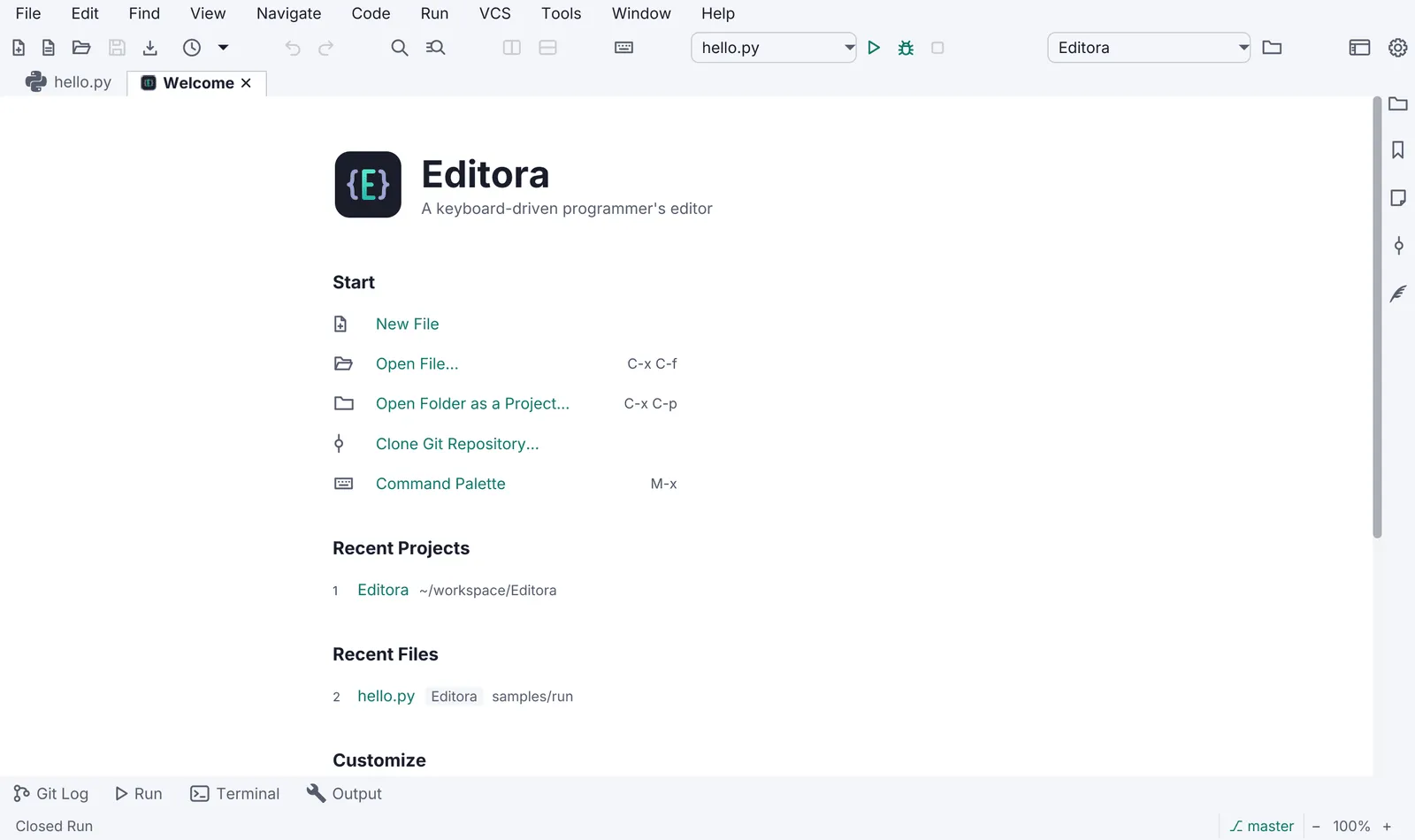
Torrenta has no documents to come back to, so its welcome is an empty state over the table until the first
torrent (ui/Welcome.java, bound to the list being empty): a drop zone that says “Drop a .torrent, a magnet or a
link anywhere”, the four keys that matter with their chords (open a .torrent file, add what is on the clipboard,
filter or run a command, Settings), the clipboard’s magnet or link offered with an Add it button when there is
one, and where downloads go with a change link. Nothing on it takes focus: the keys are the way in. Termina, Mirada,
Modula and nux open straight into their content and have neither.
Pauta 1.4.1 · · Changelog · This page in the latest edition